

Background Information
Note to readers: this was not our original itinerary. Due to flight delays and rainy weather, we had to adjust our plans to fit everything in efficiently and make it work.
Other notes – We purchased the I Amsterdam card, which gave us free or discounted access to many museums and attractions as well as tram and metro service. We prefer this because it allows us to visit as much as possible without questioning if the individual ticket cost is “worth it.” It also made it easy to travel from place to place.
Because of expensive flight prices and problems with Schiphol Airport, we flew in and out of Brussels Airport, which is about 2.5 hours by train to Amsterdam. (We were always planning on leaving from Belgium.) We finally arrived in Amsterdam by the late afternoon after a flight delay, long passport control, and waiting for the next train to Amsterdam after missing it by a few minutes. We were kid free this trip and planned accordingly, doing activities that would have been much more difficult or not feasible with Allen, Joseph and Shelly in tow.
Kosher Food – Amsterdam has several kosher restaurants. Most are outside of the city center, but HaCarmel was located relatively close to our hotel. The Jewish Museum in the city also had a cafeteria that used exclusively kosher ingredients. For Shabbat, we ordered takeout food from Meat Me. There is also a Chabad that offers Shabbat meals.
Amsterdam
Day 1: Canal Cruise & Heineken Experience
Our first activity was an hour long cruise around Amsterdam’s canals. There was an audio tour, but Sam and I chose to take in the views and enjoy the beautiful ride from the back of the boat.


Heineken Experience – a short tour of the old brewery with a brief history and explanation of how beer is produced. It ends in the Heineken bar where visitors can enjoy some Heineken beer. It’s definitely a tourist trap, but we enjoyed the experience.


Day 2: Anne Frank House & Museumplein
It was just our luck that the heat wave broke when we arrived and brought an entire day of rain to Amsterdam! This forced us to rearrange our plans and visit all of the museums in one day to maximize our time indoors.
Anne Frank House – you must book tickets weeks in advance; it sells out quickly! The museum is the actual office building of Otto Frank and annex where the Frank family hid during World War II. The house is basically empty and visitors walk through the annex and can see the rooms that the families lived in. The museum gives some background about the inhabitants of the house – Otto & Edith Frank and their daughters, Margot and Anne, Auguste & Hermann van Pels and their son, Peter, and Fritz Pfeffer. The museum includes excerpts from Anne’s diary as well as audio and video clips of both the people who helped the families in hiding and of Otto Frank after the war. Honestly, there was not much to the house (it is small and given how many tourists visit, there would be no room to walk) but it was eerie/surreal to visit after hearing about it so much and it allowed me to visualize her experience. I highly recommend reading Anne Frank’s diary before visiting – it really gave context to the visit and allowed it to come to life.


We then spent some time shopping around the city center and ate lunch. We spent the rest of the day on Museumplein.
Rijksmuseum – contains classic paintings. The museum tour was sold out, so we did the audio tour of the museum highlights. Be sure to check out Vermeer’s The Milkmaid and Rembrandt’s The Night Watch. Perhaps an unpopular opinion, but I was a bit disappointed with the museum. It doesn’t compare to the museums of NYC, London, Paris, or Madrid, but I’m glad we visited nevertheless.
Van Gogh Museum – You must book in advance (at least a few days, maybe even a week). The museum shows some of Van Gogh’s collection and gives a brief history of his life. We also listened to the audio guide here. I enjoyed it, but Sam noted that Van Gogh produced so many artworks and we’ve seen many more of them in museums around the world.
Moco Museum – a modern art museum with a small collection. Not necessary to visit, but it was raining and free with our I Amsterdam Card.


Day 3: Jewish Amsterdam & Zaanse Schans
We booked a 2 hour tour of Jewish Amsterdam through the Jewish Museum. During the first hour we walked through the old Jewish quarter (which is now non-existent) and saw a few different memorials to the Dutch Jews who were killed during the Holocaust. The most recent memorial, the Dutch Holocaust Memorial of Names, lists the names of all of the Dutch Jews who perished in the shape of the Hebrew word L’zecher. From a community of 160,000 Jews, approximately 110,000 were deported and sadly only 5,000 deportees survived the war. The second hour of the tour focused on the Portuguese Synagogue and surrounding buildings. The Synagogue has been in existence since 1675. It is similar in design to a Protestant church (since the Dutch were Protestant) and is therefore not as ornate as some of the synagogues that we’ve visited in Western Europe which are similar in design to Catholic churches. The Synagogue was able to seat 1,600 people! We also saw some historical artifacts from the Jewish community, some that were hundreds of years old. It really drove home the fact that the Jewish nation lives – Am Yisrael Chai. As much as our enemies try to destroy the Jewish people, we will always live and our traditions will stay strong. We then stopped for a quick visit to the Jewish Museum, which I found unimpressive, oddly omitting the Holocaust.


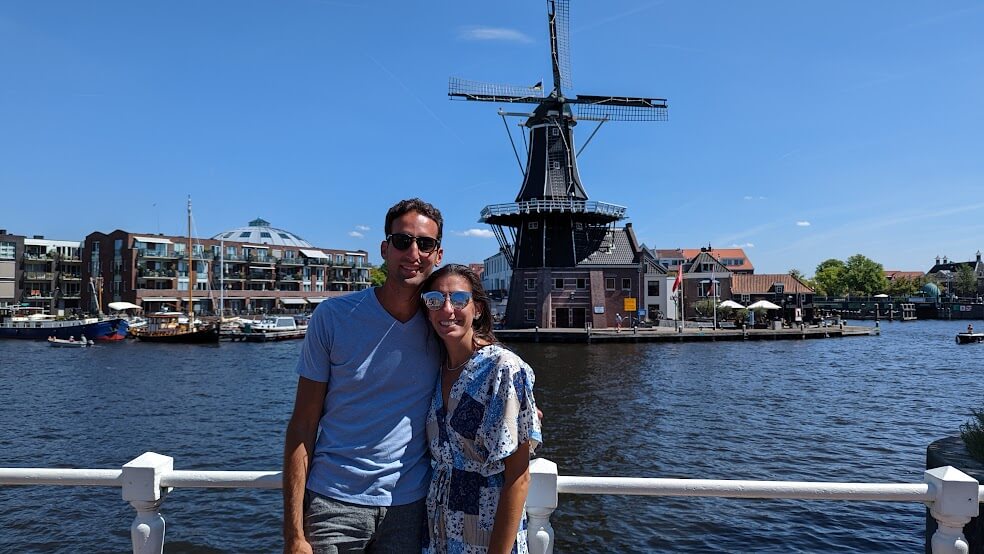
For the rest of the day, we did as the Dutch did and traveled by bike! It was about an hour ride to Zaanse Schans, a neighborhood filled with windmills, green wooden houses and interactive exhibits. The ride there was not particularly scenic, but it was exhilarating to ride in the bike lanes throughout the city/countryside. We walked through the small town visiting the windmills, clog shop, and other stores. It was a quaint town and relaxing experience. The ride back to Amsterdam was more picturesque and fun. The bikes made it easy to get around and we made several stops before the hotel, including the NDSM outdoor art murals and the Sensational Swing ride at the A’DAM Lookout.


Day 4: Shabbat
Shabbat started very late for us at 9:30 and ended even later at 10:54. We prayed at the Portuguese Synagogue in the morning; the prayers were very similar to our Sephardic prayers. Some interesting things- they have a special prayer for the monarch’s birthday, the MiSheberach was in Portuguese and the ayin was pronounced like “ng.” Sam got to carry the Torah, which also meant that he got to sit on the bima for the entire parasha reading. We stayed for kiddush before heading to the Hermitage Museum. We then headed back to our hotel for lunch and relaxed the rest of the afternoon. We spent an hour at the Stedelijk, a (very) modern art museum.
Day 5: Haarlem
We came into the trip unsure of what we would do on this day. Trains to Antwerp were selling out so we had to buy one before we left for our trip. Our train was at 4:45 so we essentially had most of the day to explore. There wasn’t enough time to go to Rotterdam or the Hague, so we ended up in Haarlem, which is about a 15 minute train ride from Amsterdam. From there, we biked to the beach through the Zuid-Kennemerland National Park. The ride was extremely windy and although it was beautiful, it was a very challenging ride. Once back in Haarlem, we stopped at the Teylers Museum, which showcased objects from the 1800s, but mostly just rode around town for a bit before taking the train back to Amsterdam to catch our train to Antwerp.


Belgium
Day 6: Ieper & Ghent & Antwerp
Note: we traveled throughout Belgium on its train system. Download the SNCB app for easy trip planning.
Ieper / Ypres: This was a hidden gem of Belgium! I highly recommend a tour of the World War I cemeteries. We toured with Salient Tours. Ieper became an important battlefield on the Western front during World War I. Deaths may have surpassed one million, and huge military cemeteries can be found all around the town. We visited the Essex Farm Cemetery, Langemark German Cemetery, the Brooding Soldier Memorial which honors the Canadians who lost their lives in the gas attacks, and the Tyne Cot Cemetery. We also saw the John McCrae memorial, which honors the life of Dr. John McCrae, who treated the wounded and wrote the famous poem “In Flanders Field.” The most surreal part of the tour was a trip to a restored trench. (Note: The stones were not part of the original trench; they merely act as a placeholder for the location of the original trench.)
 World War I rifle
 Tyne Cot Cemetery
 trench warfare
 Brooding Soldier Memorial
 grave of one of the youngest soldiers
 one of a few Jewish graves
 Trench warfare
Ghent: a picturesque port city. We visited St. Bavo’s Cathedral where we saw The Adoration of the Mystic Lamb AKA The Ghent Altarpiece that was completed by Jan van Eyck. We went to the top of the bell tower and walked around tasting the delicacies of the town- chocolate and cuberdon – and marveling at the medieval architecture.


Antwerp: Antwerp has a relatively large Jewish community with many restaurants, bakeries, shuls. It felt like I was in Boro Park. We found a great place – Hoffys takeaway restaurant- where we bought some food for lunch for the next days. For more information on kosher in Antwerp, check out Busy in Brooklyn’s blog post. The first night we walked around the Jewish neighborhood and made a brief stop at the Holocaust memorial before returning to the hotel. The second night we walked to the port and took a ride on the ferris wheel.


Day 7: Brussels & Bruges
Brussels: I insisted that we visit the capital before spending the day in Bruges. The Royal Palace is only open to the public for one month during the year and it happened to be when we were there, so we squeezed this city in. We walked through the city center, smelled the delicious chocolate and waffles, and laughed at the Mannekin Pis statue.

 Mannekin Pis
 Royal Palace
 Royal Palace
Bruges: This was probably the most beautiful town that we visited. The city maintained its old architectural style and the buildings, canals, and trees are gorgeous. Again the rain forced use to adjust our plans and we took a taxi to the Groeninge Museum, where we learned about some famous paintings from Bruges during the 16th-18th centuries. The entire town is walkable and we must have passed through the same sites 3-4 times. After the rain stopped, we climbed the 366 steps of the Belfry, ate some chocolate, saw Jesus’ blood, took a canal boat ride and snapped some beautiful pictures. It was a great day.